About Stacey Brown-Sommers

Stacey Brown is the owner of a growing agency, Mindlink Resources, LLC, based in Portland, Ore. Mindlink’s focus is to build teams of talented people providing Quality Assurance, Translation, and Interpretation for the localization industry. Stacey has been involved in the software industry for almost 20 years and has worked in localization for more than 12 years. She has a degree in Communications and an MBA in Technology Management. Recently, Stacey was certified as a Whole Person Life Coach. She plans on integrating coaching as a way to help freelancers achieve success. She lives with her partner, step-daughter and three cats near the Columbia River Gorge in Washougal, Wash.

5 Easy Ways to Provide Language Access to Families with Limited English Proficiency

immigrant-family

Speaking a language other than English at home is a reality for one in five Americans.

People with limited English-speaking abilities report that language barriers have prevented them from accessing a number of essential services, including:

  • Health care (31%)
  • Applying for government services (25%)
  • Education (24%)

Are we doing enough to make these people feel included in our communities? If you work in education, government, health care, non-profits, or any agency that helps the community, you need to ask yourselves how to be more inclusive.  A simple way to make a huge difference for people is to provide language access to families who have limited English speaking abilities.

Language access – translation or localization services – helps break down these walls and lets them know that you want to help them regardless of the language they speak.

Also, language access isn’t just the right thing to do—if your organization receives federal money, it may also be a legal requirement.

Title VI of the Civil Rights Act of 1964 requires recipients of Federal financial assistance to take reasonable steps to make their programs, services, and activities accessible by eligible people with limited English proficiency.

5 Practical Steps Toward Inclusion for Multilingual Families

Including families with limited English-speaking abilities doesn’t have to be difficult and it doesn’t have to cost a fortune. Here are five ways you can help these families feel welcome and included:

Translate essential materials for accessing your service

As noted above, if you take federal funding in any way, you may be required to translate essential documents in order to provide meaningful access for your service. Regardless of those requirements, providing materials in the common languages spoken in your communities can help people take full advantage of services they need and feel welcome. If you identify even a few documents, brochures, application forms, etc. that you can translate for communities, that can help a lot.

Be prepared for translation requests by analyzing the specific demographics of your community. For instance, if a significant portion of your community speaks Spanish and Vietnamese, proactively translating critical documents into these languages can greatly enhance accessibility. This targeted approach makes critical information available to everyone, fosters a welcoming environment, and encourages greater participation from all community members.

To help you get started, the Centers for Medicare and Medicaid Services maintains a list of the top non-English languages spoken in each state. 

Schedule a face-to-face interpreter for in-person and virtual meetings

It’s easier than ever to add an interpreter in a meeting! Most virtual meeting systems (like Zoom) support adding interpreters. Interpreters are also available on-site, over-the-phone, or remotely via video.

Interpreters not only provide language services, they also act as cultural brokers to bridge communication gaps.

To get the most out of your time with an interpreter, here are some simple tips:

  • Provide materials in advance: Give interpreters any relevant meeting materials beforehand to allow for thorough preparation.
  • Introduce interpreters early: Start the meeting by introducing the interpreters and explaining their role to everyone present.
  • Pause regularly: Encourage speakers to pause after each statement, giving interpreters time to translate accurately and completely.
  • Use easy scheduling tools: Providers like Mindlink offer easy-to-use portals for quickly scheduling interpreters, making the process streamlined and efficient.

Offer over-the-phone interpretation

If you operate a telephone hotline, it’s crucial to ensure its accessible to non-English speakers. Partner with a reliable interpreting service that can instantly connect interpreters to your calls.

To get the most out of this service, make sure your staff is trained on how to access interpreters and best practices for working with them. Also, make sure your community knows you have over-the-phone interpretation available.

Add subtitles to video content

Adding accurate subtitles to your videos is an effective way to boost understanding and foster inclusiveness. This feature is available on most video platforms like YouTube, making it simple to implement.

When uploading your video, you can easily add subtitle tracks in different languages. Tools within these platforms guide you through synchronizing the text with the audio. Including both English (or the source language) and a translated language not only enhances accessibility but also helps viewers who are learning English or prefer their native language for better understanding.

Plus, it benefits the deaf and hard-of-hearing community, giving everyone equal access to the information in your videos.

Translate your website

Yes, Google has made it easy to get machine-translated versions of many websites. Yet, Google Translate isn’t perfect, and human-powered translation for web pages remains crucial for inclusivity. Unlike machine translations, human translators understand cultural nuances and can adapt content to be more relatable and accurate for your audience.

This human touch not only improves comprehension but also demonstrates your commitment to making sure everyone has a top-quality user experience when they visit you online.

When translating key pages on your website—like service descriptions, contact information, and FAQs—consider these best practices:

  • Select relevant content: If you can’t translate everything, focus on core pages that provide essential information.
  • Update regularly: Keep all translated content current, accurate and relevant.
  • Mind the design: Make sure that the layout and graphics are culturally appropriate and designed to support text in multiple languages. If your site images include text, don’t forget to translate the text.

From Inclusion to Empowerment with Language Access

Language access is more than just a “nice-to-have”, it’s key to empowering non-native English speakers, helping them take full advantage of the services you offer, and helping them thrive by improving outcomes in critical areas like health and education.

Here are just a few of the many examples of how language access changes lives that we’ve seen in our experience:

  • Interpreting services helped Stanly, a first responder at the World Trade Center whose native language was Polish, to overcome the trauma of that experience.
  • The availability of translated communications and interpreting services in Vietnamese helped the parent of Giang, a Vietnamese-speaking child, address his truancy and get him back into school.
  • A Hindi-English interpreter helped Nirmala, an Indian woman, get the right treatment in the emergency room for her severe abdominal pain.

Creating a formal language access plan makes it easier to provide language access services and to make sure everyone in your community gets the help they need from your organization. To help you get started, download our free Straightforward Guide to Language Access Planning.

Are you ready to go beyond inclusion and start engaging equally with community members regardless of their English-speaking ability? Contact us for a free consultation!


The Human Faces of Language Access: People in Your Community Benefitting from Translation or Interpretation

Language access – receiving information and materials in one’s own language — is a human right and critical for helping non-native English speakers thrive in our communities.

Every day, interpreters and translators get to use their language expertise and cultural intelligence to help people resolve legal and financial issues, get past trauma, receive medical support, thrive at school, and take advantage of any other assistance they need.

Here, we share six incredible examples of how language access services have impacted people’s lives.

Stanly: Getting past trauma

Stanly, a many from Poland, was a first responder at the World Trade Center tragedy. Because of his experience and the aftermath, he developed PTSD and began to see a therapist for help.  He did speak English at a basic level, but because the subjects were so personal to him he found it very hard to communicate in English. Once we brought in a bilingual and emotionally intelligent Polish interpreter, Stanly found it much easier to express himself at the emotional level necessary to begin processing his feelings.  Over several months he was able to enjoy the sessions, work through his trauma, begin to heal, and as a result he began to succeed and thrive again at work and in his personal life.

Nirmala: Receiving emergency treatment

Nirmala, and Indian woman, went to the hospital on Christmas day because she had severe abdominal pain. The medical professionals asked many questions, but Nirmala had hard time understanding their questions and explaining her symptoms and situation in English.  Once a Hindi/English interpreter arrived and was able to help her, the doctors properly diagnosed her issues, provided the right treatment and sent her home for Christmas with her family. This interpreter brought emotional intelligence, cultural understanding, and domain expertise as well as linguistic fluency to the situation.

Omid: Treating mental health issues

A teenage refugee from Afghanistan, Omid, was struggling with insomnia, stomach pains, and anxiety. His doctor was unable to get clear details from him in order to help him resolve the mental and physical health issues that were hurting his quality of life.  Omid, whose English is emerging but is not yet fluent, didn’t understand the questions, and felt uncomfortable talking with her because she was an unmarried woman with uncovered hair.  Once a bilingual male interpreter came in, Omid and the doctor were able to communicate clearly through him, and the doctor was able to prescribe medicine to help Omid. Importantly, Omid was able to get clear instructions about how to take the medicine.

Giang: Resolving school truancy

Giang, a Vietnamese speaking child, skipped school enough times that the school sent the parents an email message to ask about his well-being.  However, the parents didn’t understand the automatic email and phone messages, and were unable to connect with the details of the absences, the consequences of them, and who to talk with to resolve them. Once the language access coordinator got involved, the parents received communications in Vietnamese and were able to understand and resolve the absences and get their child back in school.

Raquel: Empowering entrepreneurship

Raquel, a young woman from Colombia, began a custodial services business in the United States, and needed a loan for equipment and banking support for payments and payroll processing.  The bank she chose provided her with all materials in Spanish, and the banker was a Spanish-speaker himself. Raquel was able to set up the accounts and finances that she needed for his business to thrive.

Anton: Resolving a bank dispute

A Ukrainian man named Anton was involved in a dispute with their bank. The bank was saying that Anton was behind mortgage payments, but he insisted he made payments as scheduled. It turned out that the issue started when Anton changed jobs and started working on a commercial fishing boat. His new job was seasonal, meaning there were months when he would be out in the sea and months when he didn’t work at all. His paychecks were quite sizable for the time he spent working but he didn’t have any income off season. He was overpaying his mortgage when he had income but when he didn’t receive paychecks, he was not making any payments towards the mortgage. He didn’t understand that the extra money was not covering the mortgage for the months he didn’t make any payments. Once an interpreter got involved, the 2 parties were able to clear up the situation and create a good solution.  They opened a savings account, connected it with Anton’s mortgage account, and set up automatic transfers in an agreed amount.

To chat with us about how language service can help your organization better serve your community, contact us here. 

5 Things You Can Do to Include Families with Limited English Speaking Abilities

If you work in education, governments, health care, non-profits, or any agency that helps the community, you probably ask yourselves how to be more inclusive. A simple way to make a huge difference for people is to provide language access for families who have limited English speaking abilities.

Did you know a lot of our community members feel shame about their English speaking abilities? It’s true. And this shame results in many people not engaging with available services and support.

Did you know that the U.S. does not have an official language? We happen to speak a lot of English here, but it isn’t required. In fact, the US is the 5th most linguistically diverse country in the world! Also, Title VI of the Civil Rights Act of 1964 requires recipients of Federal financial assistance to take reasonable steps to make their programs, services, and activities accessible by eligible persons with limited English proficiency.

So how do we help community members overcome those feelings of shame and make sure they know they can engage with you regardless of the language they speak.

Here are a few things you can do that don’t have to cost a fortune.

Translate essential materials for accessing your service

If you identify even a few documents, brochures, application forms, etc. that you can translate for communities, that can help a lot. In fact, if you take federal funding in anyway, you may be required to provide meaningful access to your service. Providing materials in the common languages spoken in your communities can help people feel welcome.

Schedule an interpreter for meetings (even virtual ones)

It’s easier than ever to add an interpreter in a meeting! Most virtual meeting systems (like zoom) support adding interpreters. Having interpreters available can provide both the language services and can serve as a cultural broker to ensure that you’re bridging the language gap.

Need to Schedule Someone Now–Check out LinguistLink!

Add subtitles to video content

Providing accurate subtitles is a great way to show inclusiveness. You can easily add subtitles to your training and marketing videos. It’s supported on most video platforms (like youtube!) It’s a great idea to add English (or the source language) as well as the translated language. Many of your community members prefer to read the subtitles when watching videos.

Include option to provide interpretation on a hotline

If you have a telephone hotline, it’s important to have a plan for when someone calls the hotline who doesn’t speak English. Having a partner with interpreters ready to conference in can smoothly enable services.

Yes, Mindlink can help with this 😀

Create human translated web pages

If you have a website — providing pages in the languages spoken in the community that is translated by human makes a big difference in showing the public you have an inclusive and welcoming organization. Just translated a few core pages can make a huge difference.

Yes, Mindlink can help with this too! 😀

Let’s go beyond just including, and strive to engage with community members regardless of their English speaking ability.

Schedule a Free 15 min Consultation with Stacey

I would love to talk with you about what you’re currently doing and give some ideas for some things you can put into place to show your commitment to Equity, Inclusion and Engagement!

How to hold Inclusive Virtual Back-to-School Meetings

Who knew how much could change in a year? With classrooms going remote throughout the country, educators are faced with having to figure out what may have been seen as impossible, like holding inclusive virtual back-to-school meetings. But, we are in a season of making the impossible, possible.

Before scheduling a meeting for your diverse school or district, there are some things to consider to make sure your meeting is inclusive regardless of English abilities.

Hire Experienced Simultaneous Interpreters

Although many interpreters may not have experience with virtual interpretation (we’re all learning in this new world!). There are interpreters who have experience providing simultaneous interpretation. This is a specialized skill, so it’s important to ask someone if they are comfortable with this task. If they aren’t comfortable providing interpretation in a meeting in person, they may struggle online.

Remember -- for meetings over two hours, 
plan on having two interpreters!

Provide a secondary audio channel

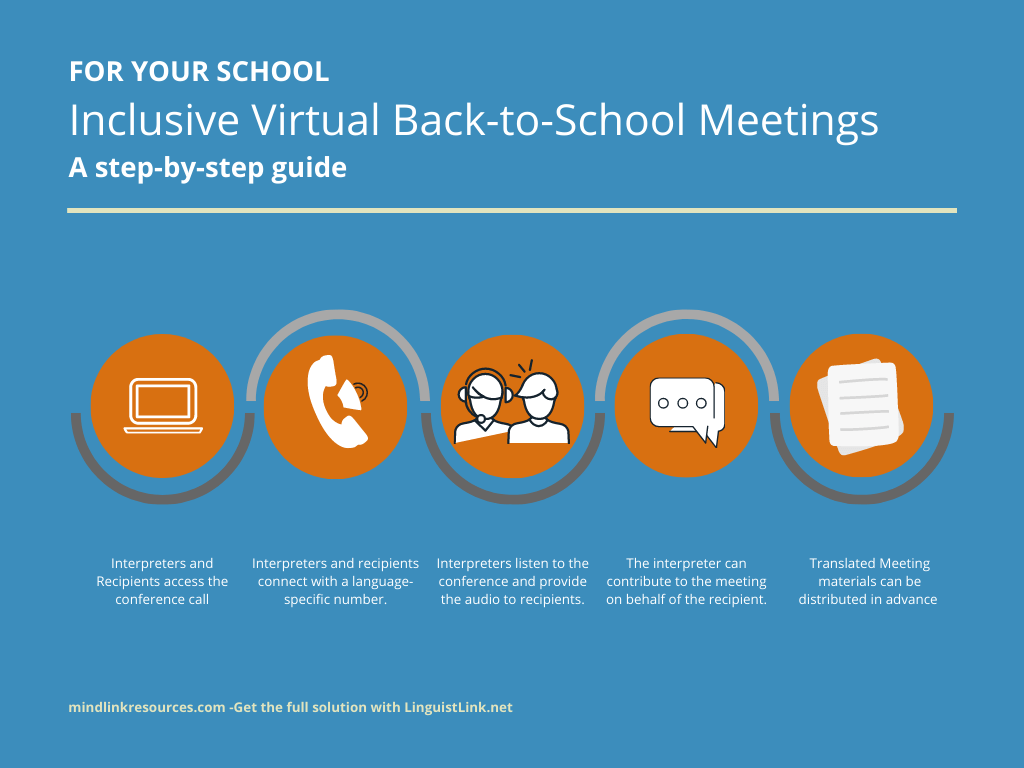
Once you have the interpreters hired, you have to make sure the right set up is in place for the call. Some conferencing tools (like zoom) have features to enable interpretation. However, they can be costly and complex. You may already have access to everything you need! Check out this infographic that will walk you through an effective set up for holding inclusive virtual back-to-school meetings.

Order a Linguist Conference Line for Your Next Virtual Meeting

Try it for FREE

Provide materials to the interpreters in advance

You can do a lot to help Interpreters prepare for the meeting. If there is an agenda, slides, or other materials, it’s great to share that a day or two before the meeting is scheduled.

Provide Translated Materials

You can really help facilitate inclusive communication by providing agendas, slides, and support materials in their language.

Inform Speakers that there will be Interpretation

If you have multiple speakers in a meeting, make sure every speaker realizes there will be interpretation provided. They should ensure their talk, slides, etc. are culturally appropriate and inclusive. Also, they can be prepared for speaking a little slower, pausing when needed, clarifying some points for the interpreter as they go along.

Give room for input from the limited English speakers in the meeting

Some meetings allow for comments/questions from the audience. Make sure to instruct participants on how to communicate their questions and input through their interpreter.

Let everyone know that you value their contribution

It goes without saying that families, regardless of their English proficiency, care about their kids and want to contribute. By providing interpretation and allowing space for participation enriches the whole school community.

It’s a new world on how we accomplish inclusive virtual back-to-school meetings, but keeping the big picture in mind can build a community that will contribute solutions now and going forward!

“It always seems impossible until it’s done.”

-Nelson Mandela

Tips to Ensure High Quality Translation

During this COVID-19 crisis, quality translation can be easily forgotten as there is a lot of moving parts and some pressure to get information out fast. Some have been tempted to just quickly run text through google translate or even skip translation altogether.

Even though the pressure to get information out is real, I would recommend taking a few extra steps that will help ensure that your meaning, tone, and message is conveyed regardless of the language. I’ll indicate (just my opinion/experience) what I believe the quality score is for each process.

  • Translation, Revision, Proofreading

    quality score: good-excellent

    Ideally, every document is assigned to professional translator to convert it to the target language. It always pays to have a second translator review their work as a second pair of eyes. Even the best, most experienced linguist can miss a word or meaning. It helps to work in a bilingual format for the first two steps of this process. It helps to divide the document up and focus on the language.

    Download a FREE bilingual translation template here.

    Once the translation/review has been completed, you can format the new document using the target text. You will need a linguist to proofread the text in the final format.

    This method is our standard for every project. The level of quality depends on the linguists, the subject matter, etc. So, it can vary somewhat. For most content this is a great way to get solid translations that meet the source.

  • Back Translation

    quality score: excellent

    If you want to be more involved in the process, asking for a “back translation” might be the way to go. Back Translation includes a step where a translator will translate the target text BACK into English. Then, an English speaker can compare the source English file and the back translated file to look for any tone, meaning, mistranslated text.

  • Parallel translation

    quality score: it better be awesome

    Another option for extra quality steps would be to have two professional translators provide the source text in parallel. Then have a third linguist ‘reconcile’ the translation. This can help alleviate human errors in handling the text. This is useful for sensitive topics like health care.

  • Can’t wait? Try Post Editing

    quality score: pretty good

    Sometimes we want to provide high quality, but we’re limited by time and budget. But, like Theodore Roosevelt said “Do what you can, with what you have, where you are.”

    Depending on the target language, technology is improving all the time to help! Machine translation (like google translate) can work in a pinch. Especially if you just need the “jist” of the message to come across.

    I highly recommend adding a post editing step where a linguist will review and make changes to the text. This way it can still sound human.

    If you have a pretty straightforward document, you can Try Automatic Translation for Free!


“Do what you can, with what you have, where you are.”

Theodore Roosevelt